Table of content

A cubic inch to cubic yard converter turns in³ into yd³ right away. Type your cubic inches, choose decimal precision, and get a clean result you can use for material estimates, shipping volume, or project math—without manual conversions.
If you’ve got a volume in cubic inches (in³) and need it in cubic yards (yd³), this tool gives you the result instantly. It’s a clean way to convert anything from small container volumes to big project estimates—without manual calculations.
Enter your value in cubic inches (in³).
Type the number exactly as you have it (decimals are fine).
Choose your decimal precision (optional).
Pick how many decimal places you want (for example: 2 for a quick read, 4 for more detail).
Click “Convert.”
The calculator will compute the equivalent volume in cubic yards.
Review the result in cubic yards (yd³).
You can copy the number directly into your notes, estimate, or spreadsheet.
Use “Swap” to convert the other way (optional).
If your page includes a reverse option, switch to yd³ → in³ to double-check or work backward.
After converting, take a quick second to sanity-check the size of the output: since 1 yd³ is a large unit, many conversions from in³ will show up as a decimal. If you’re using the number for ordering materials, rounding up slightly is often the safer choice.
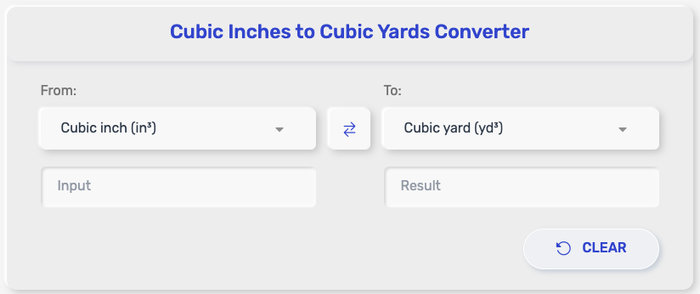
This converter is built for one job: turning cubic inches (in³) into cubic yards (yd³) fast, with a result you can actually use right away—whether you’re working with tiny volumes, big project numbers, or anything in between.
Convert in³ → yd³ instantly from a single input
Accept whole numbers and decimals (like 12.5 in³)
Handle very large values (useful for bulk estimates)
Let you choose decimal places so the result isn’t overly long
Offer a swap / reverse conversion option (yd³ → in³), if included on the page
Make it easy to copy the result for quotes, notes, or spreadsheets
If your number looks “small,” that’s normal—a cubic yard is a much larger unit than a cubic inch, so the converted value often comes out as a decimal.
Your result shows the same volume, just expressed in cubic yards (yd³) instead of cubic inches (in³).
A quick way to read it:
If your input is less than 46,656 in³, your result will be less than 1 yd³ (usually a decimal).
If your input is exactly 46,656 in³, your result is 1 yd³.
If your input is bigger than 46,656 in³, your result will be more than 1 yd³.
Example:
If you enter 10,000 in³, the output will be a small fraction of a cubic yard—that’s normal, because a cubic yard represents a much larger volume.
If you’re using the number for ordering bulk material (soil, mulch, gravel), it’s common to round up a bit so you don’t come up short.
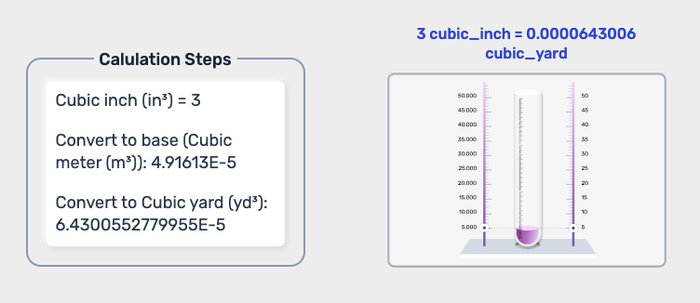
Here’s the exact relationship the converter uses:
1 yd³ = 46,656 in³
yd³ = in³ ÷ 46,656
yd³ = in³ × ¹⁄46,656
If you just want common numbers without typing anything in, use this quick table as a fast check (values shown are rounded to 6 decimals).
|
Cubic inches (in³) |
Cubic yards (yd³) |
|
1,000 |
0.021433 |
|
5,000 |
0.107167 |
|
10,000 |
0.214335 |
|
25,000 |
0.535837 |
|
46,656 |
1.000000 |
|
100,000 |
2.143347 |
|
250,000 |
5.358368 |
For exact work, keep a few more decimals in the converter result—or convert, then round based on what your project needs.
NIST (National Institute of Standards and Technology) – SI Units: Length (standard inch and yard definitions)
https://www.nist.gov/pml/owm/si-units-length
NIST – NIST Guide to the SI, Appendix B: Conversion Factors (yard/foot definitions and unit relationships)
https://www.nist.gov/pml/special-publication-811/nist-guide-si-appendix-b-conversion-factors
NIST – Federal Register Notice 59-5442 (1959): Refinement of Values for the Yard and the Pound (PDF)
https://www.nist.gov/document/frn-59-5442-1959pdf
NIST – Guide for the Use of the International System of Units (SI), Special Publication 811 (PDF)
https://physics.nist.gov/cuu/pdf/sp811.pdf
NIST – Handbook 44, Appendix B: Units and Systems of Measurement (PDF)
https://www.nist.gov/document/appb-19-hb44-finalpdf
1 yd³ = 46,656 in³.
Use yd³ = in³ ÷ 46,656. Enter your in³ value in the converter to get the yd³ result instantly.
Because a cubic yard is a much larger unit than a cubic inch. Most everyday in³ values convert to fractions of a yd³.
A yard measures length. A cubic yard (yd³) measures volume (length × width × height).
For quick estimates, 2–4 decimals is usually enough. For tight tolerances or comparisons, keep more decimals before rounding.
Often yes—rounding up reduces the chance of coming up short, especially when measurements aren’t perfectly exact.
Yes. It’s fine for everything from small container volumes to large bulk totals, as long as you enter the number correctly.
No. Inches → yards is a length conversion. Cubic inches → cubic yards is a volume conversion, so it uses a different factor.
Cubicinchtocubicyard.com is a simple online conversion tool designed to help users quickly convert cubic inches to cubic yards with accuracy and ease. Whether you are working on construction planning, material estimation, landscaping projects, engineering tasks, or educational calculations, this tool provides fast and reliable volume conversions without unnecessary complexity.
Our goal is to create straightforward, one-page calculators that anyone can use instantly—no registration, downloads, or complicated steps required. By entering a value in cubic inches, users can immediately receive the equivalent measurement in cubic yards, helping save time and reduce calculation errors.
This tool is useful for contractors, builders, engineers, students, DIY enthusiasts, and anyone who needs quick unit conversions for volume measurements. Cubicinchtocubicyard.com focuses on simplicity, speed, and accuracy so users can get the results they need in seconds.
Cubicinchtocubicyard.com was created and maintained by a small team of developers and tool contributors dedicated to building practical online calculators that make everyday measurements and conversions easier for everyone.
We are committed to providing a reliable and easy-to-use conversion tool while respecting user privacy and maintaining transparency.
Cubicinchtocubicyard.com does not require account registration or personal information. Any values entered into the converter are used only to perform the calculation and are not stored or shared.
While this tool is built to provide standard cubic inch to cubic yard conversions, results are intended for informational purposes only. Users should double-check important measurements for construction, engineering, commercial, or project planning needs.
By using this tool, you agree to use it responsibly and understand that Cubicinchtocubicyard.com is not liable for decisions made solely based on the converted results.
We may update this Policy from time to time to reflect improvements to the tool or changes in legal requirements. Any updates will be posted on this page for transparency.